About 89 minutes
Stars of the southern skies — Edition Insights
Stars Planets
20,246 recorded words. 2 minutes difference from this book's estimate.
View Gutenberg source #71999
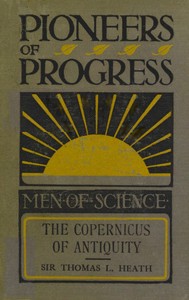
For The Copernicus of Antiquity (Aristarchus of Samos) — Inside the Classic, the stored edition analysis reports 20,921 words, 1 hr 31 min estimated reading time, and 7 detected text sections.
The text analysis averages about 28.0 words per sentence, while the detected sections provide another way to judge how the source is divided.
Project Gutenberg metadata also associates the work with “Astronomy, Greek,” connecting these edition facts with the source record’s subject description.
Explore this collection
These alternatives are selected using recorded categories and estimated reading time.
About 89 minutes
Stars Planets
20,246 recorded words. 2 minutes difference from this book's estimate.
View Gutenberg source #71999About 85 minutes
Stars Planets
19,338 recorded words. 6 minutes difference from this book's estimate.
View Gutenberg source #22157About 99 minutes
Stars Planets
22,552 recorded words. 8 minutes difference from this book's estimate.
View Gutenberg source #37916Search stored excerpts and compare books → Choose by your preferences →
Choices use stored catalog measurements. Estimates vary with reading speed. A shared category is a catalog label, not a claim that two books have the same argument or literary quality.
Search reads excerpt text stored with this catalog and links to its associated Gutenberg record. The connection is stored in the site database; this tool does not recheck that every excerpt is word-for-word identical to that external record. Excerpt search does not cover every chapter and does not verify historical publication dates.
Catalog snapshot checked: 2026-09-26. Coverage: 85 public books, 83 available source excerpts.
Calculated from edition completeness, EPUB availability, text structure and catalogue metadata. Not a user rating.
Total of 100 points, scaled to a 2.5-5.0 range. Editions with an empty description or a missing EPUB file are not scored.
Public-domain source text
The source text is kept in the dedicated reader, separate from this catalogue record and its commentary.
Heath opens by framing Aristarchus as the culmination of a Greek astronomical tradition, not an isolated genius. The book's first half surveys earlier thinkers—Thales, Anaximander, Pythagoreans, Plato, Eudoxus—showing how each contributed to the problem of planetary motion. Heath emphasizes that Greek astronomy advanced rapidly alongside pure geometry, noting that by Aristarchus's time, Archimedes had already measured curved surfaces using methods that anticipated integral calculus.
The structure itself enacts a tension: the title promises a biography of one man, but the content insists on a collective story. Heath explicitly states that the reader will find "the story, or part of the story, of many other Pioneers of Progress." This framing positions Aristarchus's heliocentric hypothesis as the logical outcome of a chain of bold speculations, not a sudden leap.
Heath devotes Part I to a chronological survey of Greek astronomy from Thales to Heraclides of Pontus. Each figure is presented as a step toward the heliocentric idea. For instance, the Pythagoreans proposed a central fire and a counter-earth, which later revisions modified by identifying the counter-earth with the moon or moving the central fire into the earth's core. Heath notes that such revisions transformed the daily revolution about the central fire into a rotation of the earth on its axis—a key precursor to Aristarchus.
Heraclides of Pontus receives particular attention. Heath reports that Heraclides argued for the earth's daily rotation and discovered that Venus and Mercury revolve around the sun. The text quotes Simplicius, who groups Heraclides with Aristarchus as thinkers who "supposed that the phenomena can be saved if the heaven and the stars are at rest while the earth moves." Heath then raises a question: did Heraclides extend this reasoning to the superior planets? He cites Schiaparelli's work suggesting that Heraclides may have anticipated a Tychonic system, but Heath leaves the matter unresolved, noting only that the question is "interesting."
Heath's editorial choices reveal a tension between narrative and evidence. He frequently inserts qualifying phrases like "so much is certain" or "a further question naturally arises," signaling where the historical record is firm versus speculative. For example, after stating that Heraclides made Venus and Mercury revolve around the sun, Heath adds: "So much is certain; but a further question naturally arises." This cautious tone contrasts with the boldness of the scientific ideas being described.
The book also juxtaposes astronomical progress with mathematical development. Heath draws a parallel between the rapid growth of Greek astronomy and the contemporaneous advances in geometry, noting that by Aristarchus's time, geometry had "covered the ground of the Elements" and solved problems beyond straight lines and circles. This comparison suggests that Heath sees astronomy and geometry as mutually reinforcing disciplines, each pushing the other forward.
Part II focuses on Aristarchus himself, but the excerpts provided are limited. The table of contents lists sections on the heliocentric hypothesis, the apparent diameter of the sun, and the sizes and distances of the sun and moon. Heath also includes a diagram from Copernicus that was anticipated by Aristarchus, visually linking the ancient and Renaissance thinkers.
Notably, Heath's account of Aristarchus is embedded within a broader narrative of "Pioneers of Progress." The book's original series title emphasizes cumulative achievement rather than individual glory. Heath's language reinforces this: he calls the pre-Aristarchan developments "the most fascinating portion of the story of Greek astronomy" and describes the earlier thinkers as having "brought the solution of the problem nearer." This framing suggests that Heath views scientific progress as a collective endeavor, with Aristarchus as its most brilliant but not solitary representative.
Readers should approach this book as a dual work: part biography, part intellectual history. Heath's emphasis on the pre-Aristarchan tradition means that Aristarchus himself appears only in the second half. The excerpts suggest that Heath is more interested in the chain of reasoning that led to heliocentrism than in Aristarchus's personal story. To fully appreciate Heath's argument, pay attention to how he handles uncertainty—his careful qualifications reveal where the historical record is thin, and where inference must fill the gaps.
The rain held steady against the window while I read how Aristarchus had quietly shifted the sun's place. His lonely math felt like a secret. Later, I reached for something lighter, and the stars on the cover of A Field Book of the Stars — Inside the Classic seemed to wink at the same old sky, just mapped from the other side.
Build a private reading journal entry for this title.