About 178 minutes
Stars and atoms — Edition Insights
Stars Planets
40,778 recorded words. 5 minutes difference from this book's estimate.
View Gutenberg source #73362
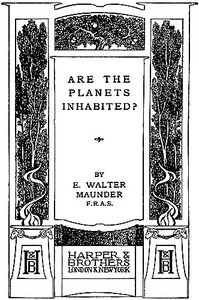
For Are the Planets Inhabited? — Story, Setting & Ideas, the stored edition analysis reports 41,950 words, 3 hr 3 min estimated reading time, and 5 detected text sections.
The text analysis averages about 27.6 words per sentence, while the detected sections provide another way to judge how the source is divided.
Project Gutenberg metadata also associates the work with “Life on other planets,” connecting these edition facts with the source record’s subject description.
Explore this collection
These alternatives are selected using recorded categories and estimated reading time.
About 178 minutes
Stars Planets
40,778 recorded words. 5 minutes difference from this book's estimate.
View Gutenberg source #73362About 164 minutes
Stars Planets
37,575 recorded words. 19 minutes difference from this book's estimate.
View Gutenberg source #71191About 216 minutes
Stars Planets
49,615 recorded words. 33 minutes difference from this book's estimate.
View Gutenberg source #28853Search stored excerpts and compare books → Choose by your preferences →
Choices use stored catalog measurements. Estimates vary with reading speed. A shared category is a catalog label, not a claim that two books have the same argument or literary quality.
Search reads excerpt text stored with this catalog and links to its associated Gutenberg record. The connection is stored in the site database; this tool does not recheck that every excerpt is word-for-word identical to that external record. Excerpt search does not cover every chapter and does not verify historical publication dates.
Catalog snapshot checked: 2026-09-26. Coverage: 85 public books, 83 available source excerpts.
Calculated from edition completeness, EPUB availability, text structure and catalogue metadata. Not a user rating.
Total of 100 points, scaled to a 2.5-5.0 range. Editions with an empty description or a missing EPUB file are not scored.
Public-domain source text
The source text is kept in the dedicated reader, separate from this catalogue record and its commentary.
Maunder opens by reframing the Copernican shift: Earth is not a fixed center but a moving, shining body among others. This inversion sets the stage for a rigorous, evidence-based inquiry into whether any planet could support life as we know it. Rather than speculate, he anchors each argument in observable data—solar output, atmospheric composition, temperature ranges—and builds a comparative framework that treats Earth as the sole known standard.
The first chapter establishes the historical pivot: once Earth was seen as a star from afar, the question of inhabited planets became urgent. Maunder does not rush to answer. Instead, he defines inhabited strictly—beings with personality, intelligence, and organic bodies. This narrows the debate, excluding mere vegetation or microbial life. He then traces the nineteenth-century Plurality of Worlds controversy, showing how earlier enthusiasm gave way to skepticism as astronomical instruments improved. The tone is measured, almost judicial, as he prepares to weigh evidence planet by planet.
Maunder’s method is strikingly visual. He constructs thermographs—temperature curves by latitude—for Earth and Mars, then overlays them to highlight differences. For Earth, the mean temperature of 16°C keeps water liquid across most latitudes. For Mars, he adjusts for a thinner atmosphere, longer year, and lack of oceans. The result: Mars is “essentially a frozen planet,” with nightly cold exceeding Earth’s polar extremes. He concludes that any Martian vegetation would need to complete its life cycle in a few daylight hours, surviving each night as spores. The diagram is not decorative; it is the core of his argument.
Maunder devotes two chapters to Mars’s famous canals, a topic then hotly debated. He does not dismiss them outright but examines their reported geometry and seasonal changes. His skepticism is grounded in the limits of telescopic resolution: at forty million miles, linear features can be optical illusions. He cites the American astronomer Newcomb, who calculated that Martian temperatures preclude liquid water on the surface. The canals, if real, would require an engineering feat beyond plausible biology. Maunder’s treatment is a model of how to test a hypothesis against physical constraints.
Moving beyond the inner solar system, Maunder considers Jupiter, Saturn, and the rest. Their low density, rapid rotation, and frigid upper atmospheres rule out Earth-like life. He speculates on a future when these planets cool, but only to note that even then, conditions would remain inhospitable. The chapter is brief, almost dismissive, as if the evidence against them is so clear that little argument is needed. This structural choice—short shrift for the outer planets—underscores his focus on the more plausible candidates: Mars and Venus.
Maunder’s book is not a survey of possibilities but a narrowing of them. He uses temperature, atmosphere, and water phase as filters, discarding worlds that fail the test. Readers should attend to his diagrams and comparative tables, which carry the argument more than prose alone. The work is a landmark of scientific caution: it asks not what we wish to find, but what the evidence permits.
After all these years, I still find myself musing on how Maunder’s careful weighing of planetary chill and thin air in Are the Planets Inhabited? feels like a quiet prelude to that grander, gentler survey of celestial order, the one I often reshelve nearby: The story of the universe. Volume 1 (of 4) — Context and Discussion. Two old friends, each listening for a distant hum.
Use these questions to collect your thoughts before moving on.