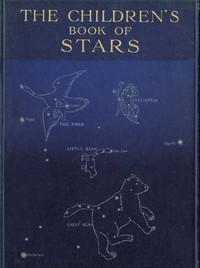
G. E. Mitton's The Children's Book of Stars (1907) opens with a striking personification: the Moon is described as a 'Moon-Child' who 'must keep on running round her.' This choice immediately signals a departure from dry astronomical exposition. Throughout the excerpts, Mitton consistently employs anthropomorphic language and vivid analogies to render celestial phenomena tangible. The comet, for instance, is depicted as a solitary traveler that 'dashes up to the sun' and then 'sinks away again' into 'cold more appalling than anything we could measure.' Such phrasing transforms abstract scientific facts into a narrative of cosmic adventure, inviting the child reader to imagine the journey alongside the comet.
Personification as a Pedagogical Tool
Mitton's most consistent authorial choice is the personification of celestial bodies. The Moon is not merely a satellite but a 'Moon-Child' with a task. Comets are given agency: they 'flash suddenly into our ken,' 'send out fan-like projections,' and 'fly' with increasing speed. This technique serves a clear pedagogical purpose: it makes the unfamiliar familiar. By framing the comet's orbit as a 'lonely journey,' Mitton taps into a child's understanding of travel and solitude. The language of motion—'dashes,' 'sweeps,' 'dwindles'—creates a dynamic, almost cinematic experience. Importantly, Mitton does not sacrifice accuracy for charm; she carefully notes that the tail 'always pointing away from the sun' is a consequence of gravitational law. The personification thus acts as a mnemonic, embedding scientific principles within a memorable narrative.
Analogies Rooted in Everyday Experience
Mitton frequently draws analogies from a child's world. The comet's nucleus is described as being wrapped in 'filmy wrappings like a cocoon of light,' evoking a familiar natural object. The heat near the sun is so intense it could 'reduce molten iron to vapour,' a comparison that leverages a child's possible knowledge of metalworking or blacksmithing. When discussing orbital periods, she contrasts a comet's 110,000-year orbit with the 'three and a half years' of smaller comets, making the scale comprehensible through juxtaposition. These analogies are not decorative; they are carefully chosen to bridge the gap between the abstract and the concrete. Mitton avoids technical jargon, preferring phrases like 'hairy or softly-glowing star' for a comet's initial appearance. This lexical choice reflects her stated aim in the Author's Note: to state 'stupendous facts in language simple enough to be read aloud to a child without paraphrase.'
Narrative Rhythm and Sentence Structure
Mitton's prose rhythm mirrors the phenomena she describes. In the comet passage, sentences grow shorter and more urgent as the comet approaches the sun: 'Faster still and faster flies the comet.' The pace then slows with the comet's retreat: 'More and more slowly it travels, always away and away.' This mimetic sentence structure reinforces the content. Mitton also uses rhetorical questions to engage the reader directly: 'What are comets?' she asks, before acknowledging that 'no one can answer definitely.' This honesty about scientific uncertainty is notable; she does not pretend to have all answers, but instead invites curiosity. The use of dashes and ellipses creates a conversational, almost breathless tone, as if the author is speaking directly to the child. The overall effect is one of intimacy and wonder, positioning the reader as a fellow explorer rather than a passive recipient of facts.
The Role of the Authorial Voice in Building Trust
Mitton establishes a distinct authorial persona: knowledgeable yet humble, enthusiastic yet precise. In the Author's Note, she credits her friend Agnes Clerke for guidance, positioning herself as a conduit for expert knowledge. This modesty extends into the main text, where she frequently uses 'we' to include the reader: 'we never know what might happen,' 'we cannot even dream of it.' This inclusive pronoun fosters a sense of shared discovery. Mitton also acknowledges the limits of human knowledge, as when she states that the comet's tail's speed 'no calculations can account for.' Such admissions build trust; the child reader learns that science is not a closed book but an ongoing inquiry. The preface by Sir David Gill further underscores the book's credibility, noting that it can 'enable parents otherwise ignorant of astronomy to answer many of those puzzling questions.' Mitton's voice, then, is carefully calibrated to be both authoritative and approachable, a balance that defines the book's enduring appeal.
Mitton's The Children's Book of Stars rewards close attention to its linguistic craft. The personification, analogies, and rhythmic prose are not mere stylistic flourishes but deliberate pedagogical strategies. Readers—whether children or adults—will find that the book's language itself models a way of thinking about the cosmos: as a place of wonder, motion, and mystery. The editorial note above has focused on the authorial choices visible in the excerpts; the full text likely extends these techniques across other celestial topics, offering a consistent and engaging introduction to astronomy.
Reading about Mitton’s gentle personification of the stars, I remembered lying on summer grass, feeling the Milky Way as a river just for me. Another book once gave me that same hush: A Plan for Securing Observations of the Variable Stars — A Closer Reading, where patient, quiet counting felt like a prayer to the dark, turning distance into something almost tender.