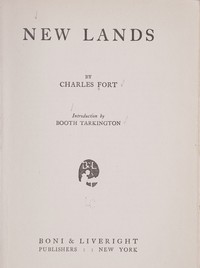
Charles Fort opens New Lands not with a thesis but with a tone: the introduction, by Booth Tarkington, recounts stumbling upon Fort's earlier The Book of the Damned and being struck by its irreverent, aphoristic style. Fort himself wastes little time before proposing that Earth may be a 'super-embryonic thing,' its parts not yet organized, and that attempts at interplanetary communication—like the changing appearance of the lunar crater Linné in the 1860s—might be premature 'protoplasmic threads' reaching out too soon. This is not a sober astronomical survey; it is a speculative, often sardonic meditation on what science has dismissed.
The Moon as a Stage for Signs
Fort seizes on a specific historical episode: between 1866 and 1867, the lunar crater Linné was observed by multiple astronomers—Schmidt, Buckingham, Dawes—to change appearance repeatedly. It turned white, then dark, then displayed a 'fine, black spot' at its center, forming a 'geometric figure that was white-bordered and centered with black.' Fort rejects the conventional explanation of sunlight effects, citing Schmidt's conclusion that sunlight had nothing to do with it. Instead, he proposes a startling image: the crater was 'terraced,' and the changing patterns were produced by 'hosts of the inhabitants of the moon standing upon the ridges,' some dressed in white, some in black, arranging themselves in living formations—like the human spectacles of flags and crosses during wartime. The argument is not that this is proven, but that it is at least as plausible as the orthodox silence.
Earth as an Appalling Deity
Fort's prose shifts into a mythic register when he imagines how lunar beings might perceive Earth. He calls it 'the Earth-god'—seen from the moon as 'a vast, bland, silvery Buddha' when mists obscure it, but when the disguise is off, 'the appalling god of carnivorousness.' The description grows more visceral: Earth is 'something thrust into a shell,' its tornado clouds like 'the fist of God, clutching rags of ultimate fire and confusion.' This is not metaphor for its own sake; it is a deliberate inversion of human-centered cosmology. Fort suggests that what we call God may be, from another world's perspective, a 'bland and shining Stupidity' or a 'menacing fist.' The passage forces the reader to consider that our planet might appear monstrous, not majestic, to an outside intelligence.
The Method of the Damned Data
Fort's approach is to collect anomalies that official science has rejected or ignored—what he calls 'damned' data. In New Lands, he extends this method to astronomy, citing reports of unidentified lights, unexplained celestial phenomena, and observations that contradict established models. He does not offer a unified theory; instead, he piles up instances, letting the sheer accumulation suggest that something is being systematically excluded. His tone is often mocking: he refers to 'pale ignorances, presiding over microscopes' and 'corpses and skeletons and mummies' that 'twitch and totter with pseudo-life derived from conveniences.' The reader is invited not to accept Fort's conclusions but to question the authority of those who dismiss the unexplained. The book is less a finished argument than a provocation to look again at what has been set aside.
Fort's New Lands is best approached as a work of intellectual rebellion rather than a systematic treatise. Readers should expect digressions, rhetorical flourishes, and a deliberate refusal to conform to academic decorum. The value lies not in whether Fort's speculations are correct, but in the questions he forces upon the reader: What counts as evidence? Who decides what is impossible? And what might we see if we were willing to entertain the damned?
There are evenings I page through New Lands and feel the sky grow less certain, more alive. It reminds me of an old friend’s dog-eared copy of A Field Book of the Stars — Inside the Classic, where every constellation was a doorway, not a fact. We were just looking for company in the dark, I think. That feeling hasn't left me.