About 363 minutes
Astronomical Curiosities: Facts and Fallacies — Edition Insights
Celestial Mechanics
83,380 recorded words. 36 minutes difference from this book's estimate.
View Gutenberg source #39263
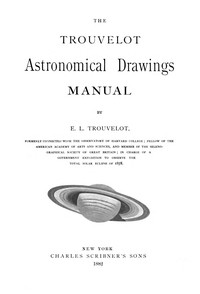
This digital edition of The Trouvelot astronomical drawings manual — Reading Notes is described by source-level measurements including 75,047 words, 5 hr 27 min estimated reading time, and 8 detected text sections.
The text analysis averages about 27.6 words per sentence, while the detected sections provide another way to judge how the source is divided.
Project Gutenberg metadata also associates the work with “Astronomy -- Pictorial works,” connecting these edition facts with the source record’s subject description.
Explore this collection
These alternatives are selected using recorded categories and estimated reading time.
About 363 minutes
Celestial Mechanics
83,380 recorded words. 36 minutes difference from this book's estimate.
View Gutenberg source #39263About 259 minutes
Celestial Mechanics
59,363 recorded words. 68 minutes difference from this book's estimate.
View Gutenberg source #33337About 410 minutes
Celestial Mechanics
94,247 recorded words. 83 minutes difference from this book's estimate.
View Gutenberg source #56302Search stored excerpts and compare books → Choose by your preferences →
Choices use stored catalog measurements. Estimates vary with reading speed. A shared category is a catalog label, not a claim that two books have the same argument or literary quality.
Search reads excerpt text stored with this catalog and links to its associated Gutenberg record. The connection is stored in the site database; this tool does not recheck that every excerpt is word-for-word identical to that external record. Excerpt search does not cover every chapter and does not verify historical publication dates.
Catalog snapshot checked: 2026-09-26. Coverage: 85 public books, 83 available source excerpts.
Calculated from edition completeness, EPUB availability, text structure and catalogue metadata. Not a user rating.
Total of 100 points, scaled to a 2.5-5.0 range. Editions with an empty description or a missing EPUB file are not scored.
Public-domain source text
The source text is kept in the dedicated reader, separate from this catalogue record and its commentary.
Trouvelot opens his manual by describing the origin of his drawings: a fifteen-year study of the heavens produced a collection of pastel illustrations exhibited at the 1876 Centennial Exhibition. He insists that his aim was to combine “scrupulous fidelity and accuracy” with the “natural elegance” of celestial objects, yet he concedes that “no human skill can reproduce upon paper the majestic beauty and radiance” of the originals. This tension between scientific exactness and artistic limitation runs throughout the work.
Trouvelot specifies the telescopes he used, ranging from 6 to 26 inches in aperture, including the “great Washington refractor” and the 26-inch telescope of the University of Virginia. He also describes a spectroscope with a diffraction grating by L. M. Rutherfurd. These details anchor his observations in specific, high-quality equipment. Yet he notes that those “unacquainted with the use of optical instruments” often misunderstand what can be seen. His manual thus serves as a corrective, teaching readers how to interpret telescopic views—and how to recognize the limits of even the best instruments.
Trouvelot devotes considerable attention to Saturn's ring system, treating it not as a static feature but as a dynamic, changing structure. He observes that the dusky ring's transparency is “not everywhere equal,” and that the particles composing it “are not permanently located.” He describes the shadow of the planet on the rings, noting that its outline is “concave towards the planet” on the middle ring but “slanting” on the outer ring. These shadow shapes prove that the rings have varying thickness and are “far from being flat throughout.” Trouvelot even compares the ring surface to “a large mass of clouds seen from the top of a high mountain,” emphasizing its impermanence.
Trouvelot uses shadows as a key tool for inferring topography. The shadow cast by Saturn on its rings reveals that the middle ring “stands at a higher level” than the others. He also notes that the shadow of the ring on Saturn's globe sometimes appears “irregular and indented,” which could indicate either an uneven planetary surface or a jagged ring edge. These observations are presented as tentative—Trouvelot acknowledges that other observers have seen similar irregularities, but he does not claim certainty. His cautious language (“as far as can be ascertained,” “it will be shown”) reflects a scientist who values evidence over assertion.
Trouvelot's drawings aim to capture phenomena that change rapidly, such as the “shadow of the globe on the rings” and the “mottled appearance” of Saturn's surface. He notes that the ring system's thickness varies, and that “the surface of the outer ring is almost level” but subject to change. His method is to combine multiple observations over time, yet he admits that the drawings can only suggest the “delicate outlines” of the originals. This section underscores the difficulty of representing dynamic celestial events in static images—a challenge that Trouvelot confronts with both technical skill and intellectual honesty.
Trouvelot's manual rewards readers who attend to his careful distinctions between what is certain, what is probable, and what remains unknown. His descriptions of Saturn's rings, in particular, show how a trained eye can detect change and irregularity where a casual observer sees only smooth bands. The drawings themselves are best studied alongside the text, as Trouvelot often points to specific features on the plates. This is not a casual guide but a working astronomer's record of what he saw—and what he could not quite render.
I found myself thinking about Trouvelot's careful, imperfect Saturn drawings long after closing the book, the way his hand tried to hold onto something so fleeting. It reminded me of how Newton's Principia — Key Ideas to Explore feels like watching someone think slowly, patiently, about the very same sky, but with numbers instead of chalk.
Your answers remain private and are stored only in this browser.