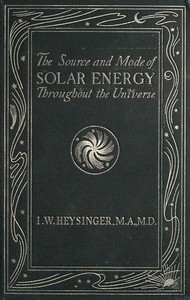
The Source and Mode of Solar Energy Throughout the Universe — Background and Themes

(0 User reviews)   1001
In Category - Celestial Mechanics
Heysinger, Isaac W. (Isaac Winter), 1842- Project Gutenberg 2018 Not confirmed
Bible and science; Solar system; Cosmogony Readers of public-domain and historical texts
Project Gutenberg digital edition en

Edition facts

Words 94,247
Reading time 410 min
Text sections 20

The Source and Mode of Solar Energy Throughout the Universe — Background and Themes can be approached with a clearer sense of reading commitment from its source measurements: 94,247 words, 6 hr 50 min estimated reading time, and 20 detected text sections.

The text analysis averages about 30.0 words per sentence, while the detected sections provide another way to judge how the source is divided.

Project Gutenberg metadata also associates the work with “Bible and science,” connecting these edition facts with the source record’s subject description.

Explore this collection

Compare your next read

These alternatives are selected using recorded categories and estimated reading time.

Search stored excerpts and compare books → Choose by your preferences →

How these choices and excerpts are prepared

Choices use stored catalog measurements. Estimates vary with reading speed. A shared category is a catalog label, not a claim that two books have the same argument or literary quality.

Search reads excerpt text stored with this catalog and links to its associated Gutenberg record. The connection is stored in the site database; this tool does not recheck that every excerpt is word-for-word identical to that external record. Excerpt search does not cover every chapter and does not verify historical publication dates.

Catalog snapshot checked: 2026-09-26. Coverage: 85 public books, 83 available source excerpts.

Heysinger argues that solar energy originates from electrical currents generated by planetary motion, using astronomical observations and biblical harmony to support a self-compensating sun.
Share
Editorial Edition Score 4.9/5

Calculated from edition completeness, EPUB availability, text structure and catalogue metadata. Not a user rating.

How this score is calculated
  • Description quality20 pts
  • Title & short description10 pts
  • Source metadata20 pts
  • Text length15 pts
  • Chapters / structure15 pts
  • EPUB file integrity20 pts

Total of 100 points, scaled to a 2.5-5.0 range. Editions with an empty description or a missing EPUB file are not scored.

Edition quality

Public-domain source text

Read the source text

The source text is kept in the dedicated reader, separate from this catalogue record and its commentary.

Heysinger opens with a striking claim: the sun is not a self-contained furnace but a receiver of electrical energy generated by the planets themselves. This premise drives a work that moves between detailed solar physics, cometary phenomena, and the nebular hypothesis, all while maintaining a steady dialogue with the Mosaic cosmogony. The book’s structure mirrors its argument—each chapter builds a case for a unified electrical universe, from sun-spot cycles to the formation of galaxies.

Recurring Images of Electrical Exchange

Throughout the excerpts, Heysinger returns to a core image: the sun and planets as linked electrical conductors. He describes the sun as a “self-compensating machine” whose volume adjusts to maintain constant energy output, and illustrates this with diagrams of “electrical polarities” and “planetary generation and transmission of electrical energy.” The language is consistently mechanistic—planets “direct” currents, the sun “expands or contracts” in response. This electrical metaphor extends to comets, which he interprets as electrical phenomena rather than icy bodies. The recurring visual of a “star in flames” (a temporary star) is explained through four stages of electrical incandescence, reinforcing the idea that all celestial activity is fundamentally electrical.

Movement Between Scales: From Sun-Spots to Galaxies

Heysinger’s argument moves fluidly between the microscopic and the cosmic. A typical sun-spot is analyzed in detail (Figure 19), yet he also speculates about “thickly-peopled region[s] of space” where adjacent solar systems might exchange electrical currents. This shift in scale is deliberate: he uses local phenomena (sun-spot cycles, planetary positions) to infer universal laws. The book’s chapter sequence mirrors this movement—from the sun’s constitution (Chapter II) to the phenomena of stars (Chapter VI) and finally to the “Genesis of Solar Systems and Galaxies” (Chapter XIII). The reader is constantly asked to see the same electrical principles operating at every level.

The Role of the Nebular Hypothesis

Chapter XII directly addresses the nebular hypothesis, which Heysinger both uses and critiques. He presents it as a foundation—the idea that solar systems develop from “attenuated matter of space”—but modifies it to fit his electrical model. The frontispiece shows eight stages of development, from Newton’s comet to an “ideal solar system,” suggesting a progressive, almost evolutionary view. Yet Heysinger is careful to note difficulties: he acknowledges that the nebular hypothesis has “its Basis and its Difficulties,” and his own theory of electrical generation is offered as a solution to problems like the source of solar heat. This critical engagement with existing theories gives the book a scholarly, argumentative tone.

Harmony of Science and Scripture

The final chapter, “The Mosaic Cosmogony,” and the conclusion on “The Harmony of Nature’s Laws and Operations” reveal Heysinger’s overarching goal: to reconcile astronomy with the Bible. He does not treat this as an afterthought; the book’s structure builds toward it. Earlier chapters establish a natural law—electrical energy—that he then argues is consistent with Genesis. The language is careful: he speaks of “harmony” rather than proof, and his references to “the Mosaic cosmogony” are framed as parallel accounts rather than literal interpretations. This dual audience—scientific and religious—shapes the book’s tone, which is earnest but not dogmatic.

Readers should approach this work as a period piece of scientific synthesis, where astronomy, physics, and theology are interwoven. Heysinger’s electrical theory is not current, but his method—moving from observation to universal principle—offers insight into late-19th-century scientific thought. Pay attention to the illustrations and diagrams, which are integral to his argument, and note how he uses analogy (the sun as a machine) to make complex ideas accessible.

I keep thinking about how Heysinger saw the sun as something sustained by motion, not burning itself away. That quiet sense of order staying intact stayed with me. The New Heavens — Reading Companion felt like sitting beside someone who noticed the same steady pattern in the stars, and didn’t need to say much more.

There are no reviews for this eBook.

0
0 out of 5 (0 User reviews )

Add a Review

Your Rating *
There are no comments for this eBook.

Reader reflection

How will you remember this book?

Save your reaction, strongest insight, and memorable passage.

Your progress 0 / 10
1

What is your current status with this title?

2

How did the book work for you overall?

3

Would you recommend this book to another reader?

4

How demanding did the text feel?

Related eBooks