Newton's Principia — Key Ideas to Explore

(0 User reviews)   1437
In Category - Celestial Mechanics
Newton, Isaac, 1642-1727, Chittenden, N. W. [Contributor], Motte, Andrew, 1696-1734 [Translator] Project Gutenberg 2025 Not confirmed
Mechanics -- Early works to 1800; Celestial mechanics -- Early works to 1800 Readers of public-domain and historical texts
Project Gutenberg digital edition en

Edition facts

Words 261,392
Reading time 1137 min
Text sections 52

The catalog record for Newton's Principia — Key Ideas to Explore provides practical reading context through 261,392 words, 18 hr 57 min estimated reading time, and 52 detected text sections.

The text analysis averages about 34.9 words per sentence, while the detected sections provide another way to judge how the source is divided.

Project Gutenberg metadata also associates the work with “Mechanics -- Early works to 1800,” connecting these edition facts with the source record’s subject description.

Explore this collection

Compare your next read

These alternatives are selected using recorded categories and estimated reading time.

Search stored excerpts and compare books → Choose by your preferences →

How these choices and excerpts are prepared

Choices use stored catalog measurements. Estimates vary with reading speed. A shared category is a catalog label, not a claim that two books have the same argument or literary quality.

Search reads excerpt text stored with this catalog and links to its associated Gutenberg record. The connection is stored in the site database; this tool does not recheck that every excerpt is word-for-word identical to that external record. Excerpt search does not cover every chapter and does not verify historical publication dates.

Catalog snapshot checked: 2026-09-26. Coverage: 85 public books, 83 available source excerpts.

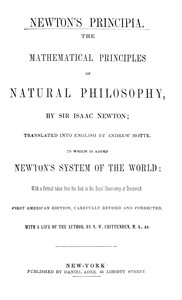
This edition of Newton's Principia, translated by Andrew Motte and revised by N. W. Chittenden, includes a dedication to New York teachers, a life of the author, and the System of the World. The text reveals Newton's experimental method through pendulum resistance trials and his geometric approach to celestial mechanics.
Share
Editorial Edition Score 4.9/5

Calculated from edition completeness, EPUB availability, text structure and catalogue metadata. Not a user rating.

How this score is calculated
  • Description quality20 pts
  • Title & short description10 pts
  • Source metadata20 pts
  • Text length15 pts
  • Chapters / structure15 pts
  • EPUB file integrity20 pts

Total of 100 points, scaled to a 2.5-5.0 range. Editions with an empty description or a missing EPUB file are not scored.

Edition quality

This 1846 American edition of Newton's Principia opens not with a mathematical proposition but with a fervent dedication to the teachers of the New York Normal School. N. W. Chittenden, the editor, casts educators as the 'prime Conservators of the public weal,' warning against the 'graspings of Ambition and the corruptions of Gold.' This rhetorical framing—moral, patriotic, and urgent—stands in striking contrast to the cool, measured prose of the scientific text that follows. The volume also includes a life of Newton and his System of the World, making it a comprehensive package for 19th-century American readers.

A Dedication That Frames the Science

Chittenden's dedication is an artifact of its time, revealing how Newton's work was presented to a democratic audience. He describes a 'stirring freshness in the air' and a 'grateful dawning of a new era,' linking the study of natural philosophy to the preservation of liberty. The editor insists that rights and constitutions are insufficient; only 'rightly cultivated hearts and heads of the PEOPLE' can guard the nation. This appeal to civic duty is a far cry from the abstract geometry of the Principia, yet it sets the stage for a work that was meant to be studied, not merely admired. The dedication suggests that the editor saw Newton's methods as a tool for rational citizenship.

Experimental Precision in Pendulum Trials

The excerpts from the body of the work show Newton at his most empirical. He describes experiments with wooden and leaden pendulums, measuring oscillations and resistance. For instance, a wooden globe 'weighing ounces troy' is suspended, and Newton counts 'the oscillations in which a given part of the motion was lost.' He presents tables of data—'First descent 2 4 8 16 32 64' and 'Last ascent 3 6 12 24 48'—and derives coefficients A, B, and C from the observations. The language is procedural: 'I leave the calculation to such as are disposed to make it.' This is not a finished theorem but a record of inquiry, showing Newton's willingness to share raw data and invite verification.

Geometric Reasoning and the Role of the Reader

Newton's method is deeply geometric. He reduces pendulum motion to a cycloid, writing that 'the velocity of the pendulum is the same which a body would acquire by falling, and in its fall describing a space of 15,278 inches.' The numbers are precise, the logic stepwise. Yet the text also assumes a reader who can follow these reductions and perform their own calculations. The phrase 'I leave the calculation to such as are disposed to make it' is a recurring invitation, placing the burden of proof on the audience. This edition, with its American context and pedagogical dedication, thus positions the Principia not as a closed book but as an open exercise in rational thought.

Readers approaching this edition should note its dual character: a scientific treatise of immense rigor, and a cultural artifact shaped by its editor's vision. The dedication to teachers is not mere ornament; it signals an intent to make Newton's methods accessible to a new generation. The experimental sections reward careful attention to the interplay of data and theory, while the geometric propositions demand patience. This is a work to be worked through, not simply read.

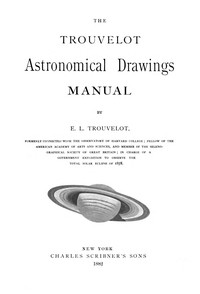
Leafing through Newton’s careful pendulum notes, I felt a quiet fondness for his patient measuring. It reminded me of another hand, equally devoted, sketching the moon’s craters with painstaking love. There is a shared tenderness in such precision, a gentle conversation across centuries. I stumbled upon that feeling again in The Trouvelot astronomical drawings manual — Reading Notes, and it felt like coming home.

There are no reviews for this eBook.

0
0 out of 5 (0 User reviews )

Add a Review

Your Rating *
There are no comments for this eBook.

Reader reflection

How did this book work for you?

Your answers remain private and are stored only in this browser.

Your progress 0 / 10
1

Which reading stage best describes you?

2

How much did you enjoy the reading experience?

3

How likely are you to recommend this book?

4

How demanding did the text feel?

Related eBooks