About 85 minutes
The New Heavens — Reading Companion
Celestial Mechanics
19,467 recorded words. 37 minutes difference from this book's estimate.
View Gutenberg source #19395
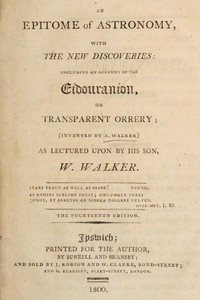
Before opening An epitome of astronomy, with the new discoveries including an account of the eídouraníon, or transparent orrery — Reading Notes, the edition data offers a quick orientation: 11,004 words, 48 min estimated reading time, and 2 detected text sections.
The text analysis averages about 30.7 words per sentence, while the detected sections provide another way to judge how the source is divided.
Project Gutenberg metadata also associates the work with “Astronomy,” connecting these edition facts with the source record’s subject description.
Explore this collection
These alternatives are selected using recorded categories and estimated reading time.
About 85 minutes
Celestial Mechanics
19,467 recorded words. 37 minutes difference from this book's estimate.
View Gutenberg source #19395About 176 minutes
Celestial Mechanics
40,432 recorded words. 128 minutes difference from this book's estimate.
View Gutenberg source #24236About 259 minutes
Celestial Mechanics
59,363 recorded words. 211 minutes difference from this book's estimate.
View Gutenberg source #33337Search stored excerpts and compare books → Choose by your preferences →
Choices use stored catalog measurements. Estimates vary with reading speed. A shared category is a catalog label, not a claim that two books have the same argument or literary quality.
Search reads excerpt text stored with this catalog and links to its associated Gutenberg record. The connection is stored in the site database; this tool does not recheck that every excerpt is word-for-word identical to that external record. Excerpt search does not cover every chapter and does not verify historical publication dates.
Catalog snapshot checked: 2026-09-26. Coverage: 85 public books, 83 available source excerpts.
Calculated from edition completeness, EPUB availability, text structure and catalogue metadata. Not a user rating.
Total of 100 points, scaled to a 2.5-5.0 range. Editions with an empty description or a missing EPUB file are not scored.
Public-domain source text
The source text is kept in the dedicated reader, separate from this catalogue record and its commentary.
The fourteenth edition of An Epitome of Astronomy is built around a single spectacular device: the Eídouraníon, or transparent orrery, a vertical machine twenty feet in diameter whose planets appear to float unsupported. Rather than presenting a continuous treatise, the work proceeds through discrete scenes—each isolating a portion of the solar system before assembling the whole. This staged structure, combined with the author's habit of moving from concrete observation to expansive inference, gives the book a distinctive rhythm: a mechanical demonstration that repeatedly opens onto metaphysical speculation.
The lecture is organized into numbered scenes, each presenting a limited configuration of celestial bodies. Scene I, for example, shows only the Sun and Earth, with the explicit rationale that “it is thought more useful to exhibit parts of the solar system, separately, before a grand display was made of the whole.” This modular approach allows the author to isolate cause-and-effect relationships—the Earth’s axial tilt producing seasons, its rotation creating day and night—before combining them. The machine itself is described as rendering truths “so plain and intelligible” that a “bare inspection” suffices. Yet the text does not rely solely on visual demonstration; it supplements each scene with explanatory prose that interprets the motions for the reader. The result is a hybrid form: part lecture script, part descriptive catalogue, part philosophical essay.
A striking structural pattern emerges as the scenes progress. Early sections treat the solar system as a closed, knowable mechanism: planets revolve, axes tilt, light radiates. But later passages abandon this tidy framework. When discussing the fixed stars, the author acknowledges that the Sun’s light cannot reach them and be reflected back, concluding they must “shine by their own light” and therefore be “Suns themselves.” From this inference, the text leaps to a vision of infinite nested systems: “systems themselves may have revolutions round one another,” and our own Sun may be “in progressive motion towards some part of infinite space.” The tone shifts from instructional clarity to something like awe, culminating in the confession that the idea “is infinitely too great for the human mind.” The movement from the orrery’s tangible spheres to the unbounded cosmos is the book’s central rhetorical arc.
Two images recur throughout the excerpts. The first is suspension: the Eídouraníon’s planets “seem suspended in space, without any support,” and the Earth is described as “suspended” in the Sun’s light. This visual motif reinforces the sense of a system held in place by unseen forces—gravity, though not named, is implied. The second image is scale. The author repeatedly measures cosmic distances against human benchmarks: light takes longer to travel from the nearest stars than “a West India voyage” (six weeks); a sound would not arrive from those stars in 50,000 years; a cannon-ball would take “a much longer time.” These comparisons make the incomprehensible tangible, but they also highlight the limits of human perception. The orrery itself is praised for its “magnificent simplicity” and “just proportions,” yet the text ultimately admits that no machine can represent infinity.
The excerpts reveal a deliberate rhetorical strategy: the author alternates between plain exposition and passages of heightened language that evoke the sublime. After describing the mechanics of day and night in Scene I, the text later declares that “the astonished fancy turns round, and is entirely lost and sunk in the abyss of nature.” The phrase echoes Edmund Burke’s notion of the sublime as a kind of delightful terror, and the author explicitly invokes the Psalmist’s “heavens declare the glory of God.” This is not mere decoration; it is a structural device. The mechanical scenes establish a baseline of rational understanding, while the speculative passages push the reader toward an emotional and spiritual response. The book thus functions as both a technical manual and a devotional work, using the orrery’s visible evidence as a springboard for contemplating the infinite.
Readers approaching this edition should attend to the interplay between the numbered scenes and the philosophical interludes. The orrery is not merely an illustration but a structuring principle: each scene isolates a piece of the system, yet the cumulative effect is to demonstrate that the system cannot be fully contained. The book’s power lies in its willingness to let the machine’s limitations become the occasion for wonder.
I remember standing in a dark planetarium as a child, feeling the weight of infinity press against my chest. Walker's transparent orrery stirred that same awe—the visible machinery hinting at something vast and unseen. Later, reading The Source and Mode of Solar Energy Throughout the Universe — Background and Themes, I felt that quiet vertigo return, the sun’s quiet work suddenly speaking of endless time.
Answer a few questions and save a private reflection on this device.