About 55 minutes
Popular lessons in astronomy, on a new plan — Background and Themes
Popular Astronomy
12,604 recorded words. 22 minutes difference from this book's estimate.
View Gutenberg source #71943
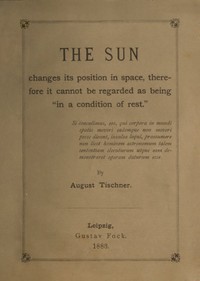
This digital edition of The Sun changes its position in space therefore it cannot be regarded as being "in a condition of rest" — Inside the Classic is described by source-level measurements including 7,395 words, 33 min estimated reading time, and 1 detected text section.
The text analysis averages about 27.6 words per sentence, while the detected sections provide another way to judge how the source is divided.
Project Gutenberg metadata also associates the work with “Solar system -- Miscellanea,” connecting these edition facts with the source record’s subject description.
Explore this collection
These alternatives are selected using recorded categories and estimated reading time.
About 55 minutes
Popular Astronomy
12,604 recorded words. 22 minutes difference from this book's estimate.
View Gutenberg source #71943About 74 minutes
Popular Astronomy
17,009 recorded words. 41 minutes difference from this book's estimate.
View Gutenberg source #78112About 91 minutes
Popular Astronomy
20,769 recorded words. 58 minutes difference from this book's estimate.
View Gutenberg source #57091Search stored excerpts and compare books → Choose by your preferences →
Choices use stored catalog measurements. Estimates vary with reading speed. A shared category is a catalog label, not a claim that two books have the same argument or literary quality.
Search reads excerpt text stored with this catalog and links to its associated Gutenberg record. The connection is stored in the site database; this tool does not recheck that every excerpt is word-for-word identical to that external record. Excerpt search does not cover every chapter and does not verify historical publication dates.
Catalog snapshot checked: 2026-09-26. Coverage: 85 public books, 83 available source excerpts.
Calculated from edition completeness, EPUB availability, text structure and catalogue metadata. Not a user rating.
Total of 100 points, scaled to a 2.5-5.0 range. Editions with an empty description or a missing EPUB file are not scored.
Public-domain source text
The source text is kept in the dedicated reader, separate from this catalogue record and its commentary.
August Tischner opens his 1883 polemic with a Latin epigram and a dedication to 'all friends of Rational Astronomy,' immediately signaling a combative stance toward established astronomy. The title itself—'The Sun changes its position in space, therefore it cannot be regarded as being in a condition of rest'—functions as a syllogistic thesis. Tischner marshals quotations from Copernicus, Mädler, and the medieval philosopher Averrhoës to frame his argument as a continuation of a long intellectual struggle. The text is not a neutral exposition but a sustained attack on what he calls the 'sophism' of treating a moving sun as effectively fixed. His prose is dense with italicized emphasis, rhetorical questions, and accusations that astronomers 'hug themselves with great complacency.' The work is as much a manifesto as a scientific treatise, and its tone is unapologetically adversarial.
Tischner's argument proceeds not through systematic evidence but through repeated assertions and appeals to authority. He juxtaposes epigraphs from Copernicus and Mädler—who declared the Copernican system 'the only possible system'—with his own claim that even a small solar motion 'overthrows the entire fabric.' The voice is that of an outsider accusing the astronomical establishment of willful blindness. He uses phrases like 'it is a very remarkable fact' and 'this fact is one of which we are right to be ashamed' to heighten moral urgency. The text is punctuated by Latin tags ('non possumus,' 'Sta, sol, ne moveare') that lend an air of scholarly gravity while also mocking the conservatism of his opponents. This rhetorical strategy prioritizes persuasion over demonstration, making the work a case study in how scientific dissent was articulated in the late nineteenth century.
Tischner does not rely solely on his own reasoning. He opens with a Latin sentence from an unnamed source and a dedication, then immediately quotes Copernicus, Mädler, and the twelfth-century philosopher Averrhoës. The Averrhoës epigraph—'An army of philosophers will not suffice to change the nature of an error and to convert it into truth'—sets the tone for a work that presents itself as a lonely crusade. Later, he cites Victor Hugo and N. Tschernychewsky, the latter remarking that a century's universal belief can become 'an absurdity so palpable' to a later age. These quotations are not merely decorative; they serve to align Tischner with a tradition of intellectual courage against entrenched dogma. By invoking Copernicus himself as an authority, Tischner attempts to turn the founder of heliocentrism against its modern defenders, arguing that Copernicus would never have proposed his system had he known the sun moves.
The text alternates between dense, italic-laden paragraphs of sustained polemic and shorter, aphoristic statements. Early passages build a cumulative case through repetition: 'the smallest movement of the sun overthrows the entire fabric of Copernicus' is followed by a cascade of consequences. Later, the pace quickens with a series of rhetorical questions—'Why is it that the astronomers of the present day are unwilling...?'—that demand an answer. The inclusion of a lengthy bibliography of works by Tischner and others (Nagy, Fahrner, Milberg, Stieber, Rohrbach) shifts the mode from argument to scholarly apparatus, suggesting a community of like-minded researchers. The final sections, devoted to Project Gutenberg's legal and fundraising information, create an abrupt tonal shift from nineteenth-century polemic to twenty-first-century boilerplate, underscoring the text's journey from pamphlet to digital artifact.
Readers should approach Tischner's text as a historical document of scientific controversy rather than a current astronomical reference. Its value lies in its unvarnished expression of a dissenting viewpoint and its rhetorical strategies, not in the accuracy of its claims. The work rewards attention to its layered use of quotations, its shifts between Latin and vernacular, and its unapologetic tone. For those interested in the sociology of science or the history of astronomical debates, this pamphlet offers a vivid snapshot of how one author attempted to unsettle a paradigm.
There’s something touching about an old astronomer so certain the sun must rest, when we know it’s always been drifting. I find myself thinking of that quiet stubbornness whenever I revisit Flowers of the Sky — Themes and Context, which feels less like argument and more like stargazing alone. Maybe both books simply miss how much motion means to us.
A brief reflection can help important ideas stay with you longer.