About 91 minutes
Astronomy for Young Australians — Context and Discussion
Popular Astronomy
20,769 recorded words. 17 minutes difference from this book's estimate.
View Gutenberg source #57091
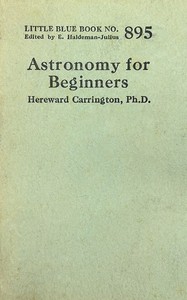
The source record for Astronomy for beginners — Reading Companion measures this digital text at 17,009 words, 1 hr 14 min estimated reading time, and 62 detected text sections.
The text analysis averages about 21.7 words per sentence, while the detected sections provide another way to judge how the source is divided.
Project Gutenberg metadata also associates the work with “Astronomy,” connecting these edition facts with the source record’s subject description.
Explore this collection
These alternatives are selected using recorded categories and estimated reading time.
About 91 minutes
Popular Astronomy
20,769 recorded words. 17 minutes difference from this book's estimate.
View Gutenberg source #57091About 93 minutes
Popular Astronomy
21,365 recorded words. 19 minutes difference from this book's estimate.
View Gutenberg source #63033About 55 minutes
Popular Astronomy
12,604 recorded words. 19 minutes difference from this book's estimate.
View Gutenberg source #71943Search stored excerpts and compare books → Choose by your preferences →
Choices use stored catalog measurements. Estimates vary with reading speed. A shared category is a catalog label, not a claim that two books have the same argument or literary quality.
Search reads excerpt text stored with this catalog and links to its associated Gutenberg record. The connection is stored in the site database; this tool does not recheck that every excerpt is word-for-word identical to that external record. Excerpt search does not cover every chapter and does not verify historical publication dates.
Catalog snapshot checked: 2026-09-26. Coverage: 85 public books, 83 available source excerpts.
Calculated from edition completeness, EPUB availability, text structure and catalogue metadata. Not a user rating.
Total of 100 points, scaled to a 2.5-5.0 range. Editions with an empty description or a missing EPUB file are not scored.
Public-domain source text
The source text is kept in the dedicated reader, separate from this catalogue record and its commentary.
Carrington opens with a declaration that astronomy is both ancient and fascinating, citing early Egyptians, Assyrians, Babylonians, and Chaldeans as great astronomers who achieved remarkable accuracy without telescopes. He then pivots to a philosophical meditation: astronomy impresses upon man his own insignificance, reducing human conflicts to 'struggles upon an ant hill.' This rhetorical move—pairing factual history with existential reflection—recurs throughout the excerpts, as when he later notes that the sun's surface temperature (5,000°C to 7,000°C) vaporizes all matter, yet enormous pressures convert vapors into 'thick, semi-fluid substances.' The tone is authoritative yet accessible, consistent with the Little Blue Book series' aim to educate a general audience.
The table of contents lists 'Astrology' as the second section, immediately after the introductory remarks. This placement suggests Carrington intended to distinguish astronomy from its pseudoscientific predecessor, though the excerpts do not reveal his treatment of astrology. The solar system section follows, with individual chapters on the Sun, Mercury, Venus, Earth, Mars, Jupiter, Saturn, Uranus, Neptune, and the minor planets. Carrington also includes a speculative chapter titled 'Are There Other Planets?'—a question that, given the 1925 publication date, predates the discovery of Pluto (1930). The excerpts do not provide his answer, but the inclusion indicates a willingness to engage with open scientific questions.
Carrington devotes several chapters to stellar phenomena. He explains that 'fixed' stars are not truly stationary but appear so due to immense distances. Double stars, he notes, often appear single to the naked eye but resolve into pairs or multiples through telescopes; some form physical systems called binaries. Colored stars exhibit complementary colors—larger stars reddish or orange, smaller ones bluish-green—while planets reflect light and thus color differently (Venus white, Mars reddish). Variable stars change in brilliance, with some regular (like Omicron, period 331 days 8 hours) and others irregular. Carrington's descriptions are concise, relying on specific examples and avoiding mathematical complexity.
The excerpts include chapters on comets, nebulae, the Milky Way, and the number of stars. Carrington estimates that many stars are 'one, two, three and perhaps five hundred thousand light-years distant,' inviting readers to calculate the miles themselves. He also covers the position and movement of our solar system, distances and temperatures of stars, and star groups or clusters. The breadth is striking: the book moves from the solar system to the galaxy to cosmology, then abruptly shifts to terrestrial phenomena like tides, thunder, lightning, fireballs, atmospheric electricity, and the aurora borealis. This eclectic mix suggests Carrington aimed to provide a comprehensive overview of 'popular astronomy' as understood in the 1920s.
Carrington's book is best approached as a snapshot of early 20th-century astronomical knowledge, filtered through a philosophical lens. Readers should note that the excerpts omit many sections (e.g., telescopes, spectroscope, photography, calendars, curved space), so the full text likely contains further technical detail. The author's habit of posing unanswered questions—like 'Are the Planets Inhabited?'—invites curiosity rather than closure. For a modern reader, the value lies not in current accuracy but in observing how a 1925 primer balanced science, speculation, and wonder.
Years ago, I held Carrington’s dear primer, feeling its gentle lesson of our smallness beneath the stars. That same hush lingers in the memoir of Herschel, who listened to the heavens so patiently. It is a quiet kinship, two voices across time, sharing one awed glance upward. Sir William Herschel: His Life and Works — Context and Discussion sits beside it now, like an old friend nodding in agreement.
Answer a few questions and save a private reflection on this device.