About 282 minutes
Astronomy for Young Folks — Reading Notes
Popular Astronomy
64,720 recorded words. 2 minutes difference from this book's estimate.
View Gutenberg source #45112
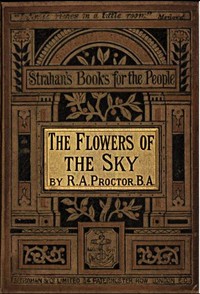
This digital edition of Flowers of the Sky — Themes and Context is described by source-level measurements including 64,358 words, 4 hr 40 min estimated reading time, and 18 detected text sections.
The text analysis averages about 29.8 words per sentence, while the detected sections provide another way to judge how the source is divided.
Project Gutenberg metadata also associates the work with “Astronomy,” connecting these edition facts with the source record’s subject description.
Explore this collection
These alternatives are selected using recorded categories and estimated reading time.
About 282 minutes
Popular Astronomy
64,720 recorded words. 2 minutes difference from this book's estimate.
View Gutenberg source #45112About 272 minutes
Popular Astronomy
62,424 recorded words. 8 minutes difference from this book's estimate.
View Gutenberg source #64649About 290 minutes
Popular Astronomy
66,582 recorded words. 10 minutes difference from this book's estimate.
View Gutenberg source #24222Search stored excerpts and compare books → Choose by your preferences →
Choices use stored catalog measurements. Estimates vary with reading speed. A shared category is a catalog label, not a claim that two books have the same argument or literary quality.
Search reads excerpt text stored with this catalog and links to its associated Gutenberg record. The connection is stored in the site database; this tool does not recheck that every excerpt is word-for-word identical to that external record. Excerpt search does not cover every chapter and does not verify historical publication dates.
Catalog snapshot checked: 2026-09-26. Coverage: 85 public books, 83 available source excerpts.
Calculated from edition completeness, EPUB availability, text structure and catalogue metadata. Not a user rating.
Total of 100 points, scaled to a 2.5-5.0 range. Editions with an empty description or a missing EPUB file are not scored.
Public-domain source text
The source text is kept in the dedicated reader, separate from this catalogue record and its commentary.
Richard A. Proctor opens Flowers of the Sky with a Shelley epigraph that frames the cosmos as a 'temple' of nature, then immediately shifts to a scientific description of light as 'waves lave the shore of that island of space which is our home.' This juxtaposition of poetic and technical language recurs throughout the work. In the chapter on Mars, Proctor notes that Galileo 'dare not affirm' he could observe the planet's phases, and he warns readers that telescopic views often disappoint compared to textbook descriptions. The author's voice is that of a patient explainer, guiding the reader through diagrams and scale comparisons—for instance, noting that on one figure's scale the sun would be 'an ordinary pin-hole.'
Each chapter begins with a poetic epigraph, often from Shelley or other Romantic poets, before launching into technical exposition. In 'Light,' Shelley's lines about the sun bathing the world are followed by a discussion of wave propagation and Sir John Herschel's assertion that light is 'superior in point of rank and conception to all other products of creative power.' Proctor does not merely decorate his text with verse; he uses it to establish a tone of wonder that the subsequent analysis does not dispel. The epigraphs serve as thematic anchors, reminding the reader that the same universe described by equations and diagrams also inspired the poets. This dual approach is consistent throughout the book, from the opening of 'The Aurora Borealis' to the chapter on 'Fancied Figures Among the Stars.'
Proctor frequently asks his audience to visualize vast distances through homely analogies. In comparing the orbits of the inner and outer planets, he explains that the scale of one figure is only one-twentieth of the other, and that on the smaller scale the sun would be 'scarcely visible.' He describes the gap between Mars and Saturn as a 'wide and barren region' crossed by the reader's gaze. These choices in diction—'barren,' 'scarcely visible'—make abstract numbers tangible. The author also uses the positions of planets in specific years (e.g., October 1877) to ground his explanations in recent events, giving the reader a temporal as well as spatial reference point. This technique recurs in the discussion of transits of Venus, where historical observations are tied to specific dates.
Proctor is careful to distinguish between what astronomers know and what a casual observer might see. He notes that Galileo could barely detect Mars's non-circular shape, and that even with a large telescope, the planet's features are elusive without 'long and careful study.' The white polar spots, now known to be ice, are described as 'regions of snow and ice, like those which surround the poles of our own earth.' Yet Proctor adds, 'But how different the reality'—a phrase that hints at the gap between expectation and direct observation. This honesty about the difficulty of astronomical work is a recurring theme: the author does not oversimplify the challenges faced by early telescopists, and he frequently cites the painstaking process of 'piecing together information obtained at various times.'
The book includes fifty-four illustrations, and Proctor integrates them into his prose with precise cross-references. In the chapter on planetary paths, he directs the reader to 'Fig. 17' and 'Fig. 18,' explaining that the dots along the orbits mark positions at intervals of ten days for inner planets and a thousand days for outer ones. The diagrams are not mere supplements but essential to the argument: the scale difference between the two figures is used to explain why Saturn, despite its size, appears dimmer than Mars. Proctor's language when describing these figures is instructional—'the places where each path crosses the plane of the earth's... are marked ☊ and ☋'—and he assumes a reader willing to follow technical notation. This integration of visual and verbal explanation is a hallmark of the book's pedagogical style.
Proctor's Flowers of the Sky rewards readers who appreciate both the poetry of the cosmos and the precision of its mechanics. The author's voice is that of a guide who respects his audience's intelligence, using analogy and diagram without condescension. Those approaching the book should expect to move between lyrical epigraphs and detailed orbital mechanics, and to encounter a 19th-century scientific perspective that is both historically instructive and, in its frankness about observational limits, surprisingly modern.
Proctor’s Flowers of the Sky always made me feel the night as a quiet garden, each star a patient bloom. I once shelved it beside Astronomy for Young Australians — Context and Discussion, and there it was—the same hush, the same wide-eyed wonder, spoken to a younger ear. Some books simply keep the same quiet company.
Build a private reading journal entry for this title.