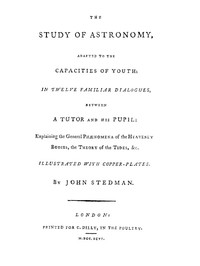
John Stedman's The Study of Astronomy, adapted to the capacities of youth (1796) opens with a preface that explicitly addresses a gap in educational publishing: few attempts had been made to make astronomy accessible to young readers. Stedman declares that existing treatises 'abound with technical terms, unintelligible to juvenile minds,' and he promises to illustrate every term so that 'no doubt on the young student’s mind' remains. The work is structured as twelve 'familiar dialogues' between a Tutor and a Pupil, a format Stedman considers 'more agreeable as well as more perspicuous to young persons, than the discouraging formality of a treatise.' The first dialogue begins with definitions of the sun, planets, and globe, immediately establishing a methodical, question-and-answer rhythm.
The Dialogue Form as a Teaching Tool
The excerpts show that Stedman uses the Tutor-Pupil exchange not merely as a framing device but as an active pedagogical method. The Pupil frequently interrupts with questions like 'Pray, Sir, can you make this clearer by an experiment?' and the Tutor responds with concrete demonstrations. In one passage, the Pupil misunderstands the word 'angle,' and the Tutor corrects him: 'That is what is generally understood by an angle: but, in geometry, it means the meeting of any two lines which incline to one another, in a certain point.' This moment reveals Stedman’s awareness that everyday meanings can obstruct scientific concepts. The dialogue allows him to anticipate and address such confusions directly, making the text a record of a live teaching interaction rather than a dry lecture.
Experiments with Household Objects
Stedman repeatedly instructs the Pupil to perform simple experiments using common items. To explain refraction, the Tutor suggests: 'Take a bason filled with water, and a strait stick or piece of wire; put it perpendicularly into the water… incline it a little towards the edge of the bason and it will appear a little bent at the surface of the water.' When the Pupil jokingly objects that he lacks a guinea to represent the sun, the Tutor adapts: 'put a shilling into the bason and call it the moon, and it will answer the same purpose.' This improvisation underscores Stedman’s practical bent. The experiment is assigned as homework: 'Well, try the experiment, and let me know the result when I next see you.' The following dialogue opens with the Pupil reporting success, showing that Stedman expects active participation and follow-through from his reader.
Geometrical Reasoning Without Diagrams
In Dialogue IX, the Tutor explains the tilt of Earth’s axis using angles and degrees, referring to a diagram (Plate III, fig. 1) that is not reproduced in the excerpts. The Pupil initially stumbles over the term 'angle,' and the Tutor defines it geometrically: 'the measure of an angle is an arc or part of the circumference of a circle, whose angular point is the center.' The explanation proceeds through a series of logical steps, with the Tutor asking leading questions ('will not its inclination from a perpendicular be 23-1/2 degrees?') and the Pupil affirming each step ('Nothing can be plainer'). This passage demonstrates that Stedman expects the reader to follow abstract spatial reasoning, even when the accompanying plate is absent. The reliance on verbal description and the Pupil’s confirmations suggests that the dialogues were designed to be self-contained, though the original copper-plates would have aided comprehension.
The Pupil’s Role as a Model Learner
Throughout the excerpts, the Pupil is not a passive recipient but an engaged, sometimes skeptical, interlocutor. He asks for clarification, admits ignorance ('I have often seen this appearance when I have put my stick into water, but did not before know the cause'), and performs experiments between sessions. His responses—'I think I understand it' or 'It is very clear'—model the ideal reader’s progression from confusion to comprehension. Stedman also allows the Pupil moments of humor, as when he smiles at the Tutor’s suggestion to use a guinea: 'Because I have not the sun’s representative to try the experiment with.' This lightness keeps the tone approachable. The Pupil’s persistent questioning and eventual mastery serve as a template for the young reader, who is implicitly encouraged to adopt the same curious and diligent attitude.
Stedman’s dialogues reward a reader who is willing to pause and perform the suggested experiments, even with improvised materials. The Tutor’s method—defining terms, using analogies, and assigning hands-on tasks—makes the book a self-guided course. Readers should note that the original copper-plates are not included in this digital edition; the verbal descriptions of diagrams may require extra attention. The errata list at the start hints at the care Stedman took with accuracy, and readers may find it useful to check those corrections as they proceed.
I have often found something tender in that old 1796 dialogue, where a tutor and pupil bend over a basin of water to catch a glimpse of the heavens bending. It reminds me of another quiet companion, The Story of Eclipses — A Closer Reading, which lingers on those moments when the sky itself seems to pause, waiting for our careful eyes. Both speak softly of patience.