About 280 minutes
Flowers of the Sky — Themes and Context
Popular Astronomy
64,358 recorded words. 8 minutes difference from this book's estimate.
View Gutenberg source #56133
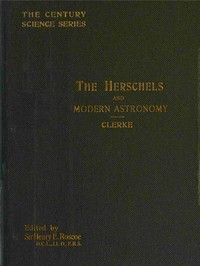
Before opening The Herschels and Modern Astronomy — Edition Insights, the edition data offers a quick orientation: 62,424 words, 4 hr 32 min estimated reading time, and 18 detected text sections.
The text analysis averages about 21.3 words per sentence, while the detected sections provide another way to judge how the source is divided.
Project Gutenberg metadata also associates the work with “Astronomy -- History,” connecting these edition facts with the source record’s subject description.
Explore this collection
These alternatives are selected using recorded categories and estimated reading time.
About 280 minutes
Popular Astronomy
64,358 recorded words. 8 minutes difference from this book's estimate.
View Gutenberg source #56133About 282 minutes
Popular Astronomy
64,720 recorded words. 10 minutes difference from this book's estimate.
View Gutenberg source #45112About 290 minutes
Popular Astronomy
66,582 recorded words. 18 minutes difference from this book's estimate.
View Gutenberg source #24222Search stored excerpts and compare books → Choose by your preferences →
Choices use stored catalog measurements. Estimates vary with reading speed. A shared category is a catalog label, not a claim that two books have the same argument or literary quality.
Search reads excerpt text stored with this catalog and links to its associated Gutenberg record. The connection is stored in the site database; this tool does not recheck that every excerpt is word-for-word identical to that external record. Excerpt search does not cover every chapter and does not verify historical publication dates.
Catalog snapshot checked: 2026-09-26. Coverage: 85 public books, 83 available source excerpts.
Calculated from edition completeness, EPUB availability, text structure and catalogue metadata. Not a user rating.
Total of 100 points, scaled to a 2.5-5.0 range. Editions with an empty description or a missing EPUB file are not scored.
Public-domain source text
The source text is kept in the dedicated reader, separate from this catalogue record and its commentary.
Agnes M. Clerke's The Herschels and Modern Astronomy (1895) builds its narrative around the physical and intellectual spaces the Herschels inhabited. The book repeatedly contrasts cramped, damp dwellings—the dilapidated gazebo at Datchet, where plaster fell and walls dripped—with the vast, ordered cosmos revealed through their telescopes. This movement between domestic discomfort and celestial discovery structures the account of William Herschel's career and Caroline's indispensable support.
Clerke treats William Herschel's instruments almost as protagonists. The "large twenty-foot" reflector marks a turning point in Caroline's duties, pulling her from independent comet-sweeping to full-time scribe. The book traces a progression from smaller reflectors to the giant 40-foot, each telescope bringing new discoveries but also new demands. Clerke notes that William was "making, not following precedents," so each instrument required improvised techniques. The physical act of building and operating these telescopes—hauling, measuring, adjusting—becomes a recurring motif, grounding abstract astronomy in concrete labor.
Caroline Herschel emerges as a figure caught between two kinds of work: domestic management and astronomical assistance. Clerke emphasizes the material conditions of her life—the scarcity of five-pound notes, the rheumatism from damp walls, the snow-covered ground she ran across at night. Her astronomical training was haphazard: "My dear brother William was my only teacher, and we began generally where we should have ended." Yet she never made a computational error. Clerke presents her as neither a passive helper nor a fully independent scientist, but as someone whose "personal wishes were suppressed" while she developed remarkable skill through practice.
The book repeatedly returns to the nocturnal rhythm of observation. Caroline's nights of "intense activity" were followed by days of "weariness and depression." Clerke describes her running in darkness, falling over a hook that entered her leg, all while maintaining the speed William demanded: "a being to execute his commands with the quickness of lightning." This alternation between night work and its physical aftermath structures the narrative of their collaboration. The telescope's movement, the clock, the lamp-micrometer—these objects punctuate the darkness, creating a sensory landscape of astronomical practice.
Clerke traces a shift in Caroline's role from independent comet-sweeper to attached scribe. In 1782 she began sweeping for comets, discovering two important nebulae. But from December 1783, she "became entirely attached to the writing-desk." This transition is not presented as a loss but as a necessary adaptation to William's evolving projects. The book uses this movement between activities—sweeping, writing, measuring—to show how the Herschels' work was never static. Each new instrument or discovery reorganized their labor, with Caroline adapting her duties accordingly.
Clerke's account rewards attention to the physical details of astronomical work: the instruments, the weather, the domestic spaces. Readers interested in the social history of science will find a nuanced portrait of collaboration under difficult conditions. The book's structure, moving between biography and technical description, mirrors the Herschels' own movement between domestic life and cosmic exploration.
I keep thinking about how the Herschels made the heavens feel like part of their home, Caroline’s quiet work beside William’s great tubes. It reminded me of another old book, A Popular History of Astronomy During the Nineteenth Century Fourth Edition — Inside the Classic, which carries that same patient, candlelit closeness to the stars—less a record than a lingering warmth.
Build a private reading journal entry for this title.