About 914 minutes
A Popular History of Astronomy During the Nineteenth Century Fourth Edition — Inside the Classic
Popular Astronomy
210,116 recorded words. 93 minutes difference from this book's estimate.
View Gutenberg source #28247
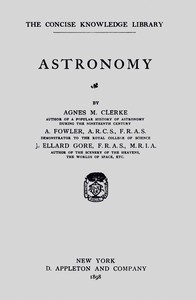
This digital edition of Astronomy — Inside the Classic is described by source-level measurements including 188,680 words, 13 hr 41 min estimated reading time, and 29 detected text sections.
The text analysis averages about 22.9 words per sentence, while the detected sections provide another way to judge how the source is divided.
Project Gutenberg metadata also associates the work with “Astronomy,” connecting these edition facts with the source record’s subject description.
Explore this collection
These alternatives are selected using recorded categories and estimated reading time.
About 914 minutes
Popular Astronomy
210,116 recorded words. 93 minutes difference from this book's estimate.
View Gutenberg source #28247About 622 minutes
Popular Astronomy
143,020 recorded words. 199 minutes difference from this book's estimate.
View Gutenberg source #40240About 618 minutes
Popular Astronomy
141,923 recorded words. 203 minutes difference from this book's estimate.
View Gutenberg source #61719Search stored excerpts and compare books → Choose by your preferences →
Choices use stored catalog measurements. Estimates vary with reading speed. A shared category is a catalog label, not a claim that two books have the same argument or literary quality.
Search reads excerpt text stored with this catalog and links to its associated Gutenberg record. The connection is stored in the site database; this tool does not recheck that every excerpt is word-for-word identical to that external record. Excerpt search does not cover every chapter and does not verify historical publication dates.
Catalog snapshot checked: 2026-09-26. Coverage: 85 public books, 83 available source excerpts.
Calculated from edition completeness, EPUB availability, text structure and catalogue metadata. Not a user rating.
Total of 100 points, scaled to a 2.5-5.0 range. Editions with an empty description or a missing EPUB file are not scored.
Public-domain source text
The source text is kept in the dedicated reader, separate from this catalogue record and its commentary.
The 1898 volume Astronomy, part of the Concise Knowledge Library, is a collaborative survey by three authors: Agnes M. Clerke, A. Fowler, and J. Ellard Gore. Its structure is explicitly divided into four sections—historical, principles and instruments, solar system, and sidereal heavens—each written by a different specialist. This division creates a deliberate movement from broad historical context to specific celestial phenomena, a pattern reflected in the prose itself, which often shifts between scales: from the vast gap between Mars and Jupiter to the intimate details of a single moon’s orbit.
The book’s preface announces its collaborative nature: Miss Clerke contributes the historical sketch and the solar system section, Mr. Fowler covers spherical and gravitational astronomy and instruments, and Mr. Gore treats the sidereal heavens. This division is not merely administrative; it produces distinct stylistic shifts. Clerke’s prose, for instance, employs vivid, almost narrative phrasing—describing the asteroid Ceres as “the missing occupant of the vacant zone” that “presented itself spontaneously.” Fowler’s sections, by contrast, are more technical, listing acknowledgments to Loomis and Young for “memorial data.” Gore’s portion, though not excerpted here, likely continues the pattern. Readers moving through the book encounter these changes in voice, which mirror the subject’s own variety: from historical narrative to mechanical description to speculative astronomy.
A striking example of the book’s attention to unusual celestial motion appears in the description of Mars’s satellites, Phobos and Deimos. The text notes that Phobos completes an orbit in 7 hours 39 minutes—less than a third of Mars’s rotation period—causing it to “rise in the west, set in the east,” a phenomenon described as “unique.” The authors calculate that during its 11-hour transit across the Martian sky, Phobos “accomplishes one entire cycle of its phases, and gets through half another.” This attention to precise timing and visual effect recurs throughout the solar system section. The passage also speculates on tidal implications, noting that Phobos’s rapid orbit would, if it raised tides, be drawn inward rather than pushed outward—a detail that “dealt a fatal blow to Laplace’s method of planetary evolution.” Such observations tie concrete measurements to broader theoretical consequences.
The chapter on asteroids opens with a spatial image: “Between the orbits of Mars and Jupiter is interposed a huge gap.” This gap, the text explains, “marks a change of front in planetary development” and “gravely compromises the symmetry of the solar system.” The language personifies the gap as a problem that “long troubled investigators.” The narrative then recounts the discovery of Ceres on January 1, 1801, followed by Pallas, Juno, and Vesta, each found near the predicted intersection of an exploded planet’s orbit. The authors present this as a series of “surprises” that verified Olbers’ hypothesis. The prose shifts between the abstract (Bode’s law, planetary evolution) and the concrete (dates, discoverers, positions). This movement from theory to discovery mirrors the book’s broader structure: each section builds from principles to specific cases, often with a sense of unfolding drama.
Throughout the excerpts, certain images recur: orbits, distances, periods, and phases. The Martian moon passage calculates brightness ratios (Phobos gives “¹⁄₆₀th that of our moon”), distances (3,700 miles from the surface), and times (132 hours between rising and setting for Deimos). The asteroid section similarly emphasizes orbital distances and the “line of intersection” where new bodies were found. This quantitative language is balanced by qualitative descriptions: Deimos’s slow motion is “nearly neutralised” by orbital circulation; Phobos’s path is “unique.” The book frequently moves between these registers, using precise numbers to anchor more speculative claims. For instance, the statement that Phobos’s orbit “points to an unique origin” follows a string of measurements. This interplay of data and interpretation is a hallmark of the work’s method.
Readers approaching this 1898 survey will find a work that shifts between authors, scales, and styles—from historical narrative to technical description to speculative astronomy. The excerpts reveal a consistent attention to the mechanics of motion: orbital periods, tidal effects, and the geometry of discovery. The book’s structure, with its clear sectional divisions, invites comparison between different authors’ treatments of similar themes. Pay attention to how each writer handles the transition from observation to inference, and how the recurring image of the “gap” or “hiatus” serves as a structural motif across sections.
There’s something touching about how those old astronomers mapped the Martian moons with such patience, knowing they’d never see them clearly themselves. It reminds me of the quiet devotion in Pioneers of Science—how each generation just handed its questions to the next. The stars kept moving; we only learned to watch them better. Pioneers of Science — Context and Discussion feels like sitting with that same slow awe.
Build a private reading journal entry for this title.