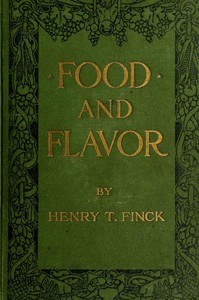
Food and Flavor: A Gastronomic Guide to Health and Good Living — Reading Notes

(0 User reviews)   1075
In Category - Popular Astronomy
Finck, Henry T., 1854-1926, Chapman, Charles Shepard, 1879-1962 [Illustrator] Project Gutenberg 2020 Not confirmed
Gastronomy Readers of public-domain and historical texts
Project Gutenberg digital edition en

Edition facts

Words 141,923
Reading time 618 min
Text sections 33

Food and Flavor: A Gastronomic Guide to Health and Good Living — Reading Notes can be approached with a clearer sense of reading commitment from its source measurements: 141,923 words, 10 hr 18 min estimated reading time, and 33 detected text sections.

The text analysis averages about 23.5 words per sentence, while the detected sections provide another way to judge how the source is divided.

Project Gutenberg metadata also associates the work with “Gastronomy,” connecting these edition facts with the source record’s subject description.

Explore this collection

Compare your next read

These alternatives are selected using recorded categories and estimated reading time.

Search stored excerpts and compare books → Choose by your preferences →

How these choices and excerpts are prepared

Choices use stored catalog measurements. Estimates vary with reading speed. A shared category is a catalog label, not a claim that two books have the same argument or literary quality.

Search reads excerpt text stored with this catalog and links to its associated Gutenberg record. The connection is stored in the site database; this tool does not recheck that every excerpt is word-for-word identical to that external record. Excerpt search does not cover every chapter and does not verify historical publication dates.

Catalog snapshot checked: 2026-09-26. Coverage: 85 public books, 83 available source excerpts.

An editorial note on how Henry T. Finck's 1913 gastronomic guide uses its opening, middle, and later excerpts to orient a first reading, focusing on flavor as a principle, historical claims, and specific food descriptions.
Share
Editorial Edition Score 4.9/5

Calculated from edition completeness, EPUB availability, text structure and catalogue metadata. Not a user rating.

How this score is calculated
  • Description quality20 pts
  • Title & short description10 pts
  • Source metadata20 pts
  • Text length15 pts
  • Chapters / structure15 pts
  • EPUB file integrity20 pts

Total of 100 points, scaled to a 2.5-5.0 range. Editions with an empty description or a missing EPUB file are not scored.

Edition quality

Public-domain source text

Read the source text

The source text is kept in the dedicated reader, separate from this catalogue record and its commentary.

Henry T. Finck opens Food and Flavor with a direct attack on what he calls “Ungastronomic America,” citing Mark Twain’s patriotic palate and Dr. Wiley’s poison squad. The table of contents reveals a structure that moves from diagnosing American food ills to prescribing flavor as a vital principle, then tours European cuisines. The excerpts show that Finck’s method is part polemic, part historical survey, and part practical guide. A first reader should note how the author uses concrete examples—like the failed candy experiment or the $30,000 spent on Camembert—to ground his arguments. The book’s 141,923 words and 33 text sections suggest a comprehensive treatment, but the excerpts offer only a partial view of its range.

Flavor as a Guiding Principle

Finck announces early that “flavor” is the guiding principle of his gastronomy. In the chapter “Vital Importance of Flavor,” he argues that sensual indulgence in eating is a duty and that flavor helps the stomach. He contrasts this with the harm done by soft foods and the folly of vegetarianism. The excerpts do not reveal his full argument, but the repeated emphasis on flavor—in the table of contents and in the Roquefort cheese description—suggests it is the book’s central thesis. Readers should watch how Finck applies this principle to specific foods, such as when he praises the “piquancy which makes the epicure’s mouth water” in Roquefort. The author’s tone is confident and prescriptive, often dismissing opposing views as blunders.

Historical Claims and Culinary Lineages

Finck traces the cradle of modern cookery to Italy, citing Katharine of Medici and the sixteenth-century supremacy of Italian chefs. He references Montaigne’s admiration for cooks who “can so curiously temper and season strange odors.” The excerpts include a digression on Roquefort cheese, which Finck claims was famous for over two thousand years and relished by ancient Romans. He also mentions the Sicilian Archestratus, who wrote a long poem on gastronomy 2250 years ago. These historical claims are presented as evidence for French and Italian gastronomic superiority. A first reader should note that Finck’s history is selective and often anecdotal, relying on figures like Voltaire and Pliny. The book’s structure—moving from France to Italy to Germany and Britain—reinforces a narrative of culinary progress centered on Europe.

Specific Food Descriptions and Production Details

The excerpts provide detailed descriptions of food production, particularly for Roquefort and Camembert cheeses. For Roquefort, Finck explains the process: bread made from wheat and barley flour with whey and vinegar is kept in a moist place until moldy, then the moldy crumbs are placed between layers of cheese curd. The cheese is ripened in natural caverns near Roquefort, ventilated by cool, moist air. He notes that the cheese is pierced with fine needles to allow mold development, creating green marbling. For Camembert, he cites New York hotels using 30,000 cheeses a week and the failure of American attempts to reproduce it, concluding that “you cannot import or reproduce local flavors.” These passages show Finck’s interest in the material conditions of food, not just its taste. Readers should compare these descriptions with his earlier chapters on denatured foods and savory cooking.

Polemical Tone and Cultural Comparisons

Finck’s writing is often polemical, as seen in his chapter titles like “Our Denatured Foods” and “The Folly of Vegetarianism.” He contrasts American and French methods, criticizing cold storage and chemical preservatives. In the cheese section, he dismisses imitations, insisting that epicures will demand the original and that law should protect them. The excerpts also show a tendency to generalize about national cuisines: French supremacy, epicurean Italy, German and Austrian delicacies, British specialties. A first reader should be aware that Finck’s comparisons are not neutral; they serve his argument for flavor as a standard. The book’s dedication to Luther Burbank and Harvey W. Wiley—two men who “have done most to make our daily food palatable and honest”—signals his alliance with the pure food movement. The excerpts do not reveal how Finck handles non-European cuisines, but the table of contents suggests a focus on Western traditions.

As you read Food and Flavor, pay attention to how Finck balances his roles as critic, historian, and advocate. The excerpts show a writer who is not afraid to name names—Mark Twain, Dr. Wiley, Carême—and who uses specific production details to support his claims. The book’s length and structure invite selective reading: you might start with the chapters on French or Italian cuisine, then return to the opening polemics. The author’s confidence in flavor as a universal principle is both the book’s strength and its limitation; consider how his evidence supports or strains that claim.

There are no reviews for this eBook.

0
0 out of 5 (0 User reviews )

Add a Review

Your Rating *
There are no comments for this eBook.

Reader reflection

How will you remember this book?

Save your reaction, strongest insight, and memorable passage.

Your progress 0 / 10
1

How far have you progressed with this book?

2

How much did you enjoy the reading experience?

3

Would you recommend this book to another reader?

4

How much effort did this book require?

Related eBooks