
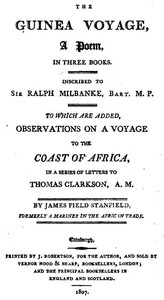
The Guinea Voyage: A Poem in Three Books by James Field Stanfield
Let's be clear from the start: 'The Guinea Voyage' is not an easy read. Published in 1789, it's a three-part poem written by James Field Stanfield, a sailor who witnessed the brutality of the slave trade firsthand. He uses his experience to craft a blistering indictment, aiming his words directly at the conscience of Britain.
The Story
The poem doesn't follow a single character's journey. Instead, it paints a sweeping picture of the entire slave trade cycle. Book I shows the violent capture of people in Africa. Book II, the longest and most harrowing, traps you in the suffocating hold of the ship during the Middle Passage—the disease, the chains, the despair. Book III lands in the West Indies, showing the sale and the bleak future of plantation life. Stanfield spares no detail, describing the sounds, the smells, and the sheer, grinding misery. It's a guided tour through hell, narrated by someone who helped run it and is now consumed by guilt and rage.
Why You Should Read It
We read a lot about the slave trade in history books, with facts and figures. This is different. This is emotion as evidence. Stanfield's fury bleeds through every line. He's not just reporting; he's accusing his readers, his country, and himself. Reading it, you get the powerful sense of a man trying to scrub a stain from his soul by making sure no one else can look away. The poetry itself is forceful, using stark, simple language to make the horror undeniable. It’s a primary source that feels alarmingly immediate.
Final Verdict
This book is for readers who want to engage with history on a visceral level, not just an intellectual one. It's perfect for anyone interested in the abolitionist movement, powerful historical testimony, or poetry used as a weapon for social change. Be warned: it will disturb you. But that's the point. Stanfield didn't write it to comfort; he wrote it to awaken. If you're ready for a challenging, emotionally draining, and profoundly important piece of writing, 'The Guinea Voyage' is a necessary journey.
This digital edition is based on a public domain text. Thank you for supporting open literature.
William Jones
2 months agoI stumbled upon this title and it challenges the reader's perspective in an intellectual way. This story will stay with me.
Nancy Lee
1 year agoVery helpful, thanks.
Aiden Moore
7 months agoAs someone who reads a lot, the depth of research presented here is truly commendable. Definitely a 5-star read.
Kimberly Harris
1 year agoA must-have for anyone studying this subject.



Donald Wilson
2 years agoHaving read the author's previous works, the logic behind each conclusion is easy to follow and verify. It definitely lives up to the reputation of the publisher.