About 512 minutes
Telescopic Work for Starlight Evenings — Reading Companion
Observational Astronomy
117,718 recorded words. 2 minutes difference from this book's estimate.
View Gutenberg source #57320
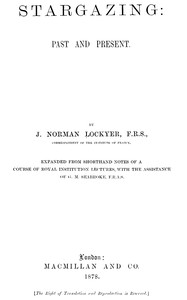
The source record for Stargazing: Past and Present — Inside the Classic measures this digital text at 117,211 words, 8 hr 30 min estimated reading time, and 24 detected text sections.
The text analysis averages about 30.4 words per sentence, while the detected sections provide another way to judge how the source is divided.
Project Gutenberg metadata also associates the work with “Astronomy,” connecting these edition facts with the source record’s subject description.
Explore this collection
These alternatives are selected using recorded categories and estimated reading time.
About 512 minutes
Observational Astronomy
117,718 recorded words. 2 minutes difference from this book's estimate.
View Gutenberg source #57320About 508 minutes
Observational Astronomy
116,670 recorded words. 2 minutes difference from this book's estimate.
View Gutenberg source #64849About 532 minutes
Observational Astronomy
122,207 recorded words. 22 minutes difference from this book's estimate.
View Gutenberg source #26556Search stored excerpts and compare books → Choose by your preferences →
Choices use stored catalog measurements. Estimates vary with reading speed. A shared category is a catalog label, not a claim that two books have the same argument or literary quality.
Search reads excerpt text stored with this catalog and links to its associated Gutenberg record. The connection is stored in the site database; this tool does not recheck that every excerpt is word-for-word identical to that external record. Excerpt search does not cover every chapter and does not verify historical publication dates.
Catalog snapshot checked: 2026-09-26. Coverage: 85 public books, 83 available source excerpts.
Calculated from edition completeness, EPUB availability, text structure and catalogue metadata. Not a user rating.
Total of 100 points, scaled to a 2.5-5.0 range. Editions with an empty description or a missing EPUB file are not scored.
Public-domain source text
The source text is kept in the dedicated reader, separate from this catalogue record and its commentary.
Lockyer opens with a frank account of the book's origin: eight Royal Institution lectures on instrumental astronomy, taken down in shorthand in 1870, then set aside until editor G. M. Seabroke prepared the notes for press. The author admits the original hours did not allow him to cover many points of interest, and that rapid progress in instrumental methods during the interval demanded further additions. This hybrid genesis—part lecture, part updated treatise—shapes the work's structure: it moves from the pre-telescopic age through early instruments to the equatorial and transit instruments of the 1870s, with woodcuts and diagrams integrated into the chapters.
The preface reveals a collaborative process. Lockyer credits Seabroke for taking the burden of preparing the notes, for important help in final revision, and for ensuring the manuscript was completed. Yet Lockyer himself then saw that the eight hours had not permitted him to touch upon many points of interest, and that progress in instrumental methods and results had been very remarkable. He therefore filled gaps and referred briefly to new instruments and methods. The resulting book is neither a pure lecture series nor a systematic textbook, but a hybrid that preserves the spoken tone while incorporating recent developments. Readers should note that the text carries traces of oral delivery—explanations that assume a live audience—alongside technical passages that assume familiarity with astronomical terms.
A central technical passage explains the relationship between sidereal and solar time. Lockyer describes how the sidereal day is shorter than the solar day by 3 minutes 56 seconds, and how a sidereal clock shows 24 hours rather than 12, often with separate dials for hours, minutes, and seconds. He notes that such clocks were once common for mean time as well, citing the dials in Venice as evidence. The explanation hinges on the concept of right ascension: the sidereal clock indicates the time when a star transits the central wire of a transit instrument. Lockyer then describes the traditional method of observation: the transit room is kept quiet so that only the ticking of the sidereal clock is heard; the observer estimates the time of transit over each wire to the tenth of a beat. A woodcut (Fig. 123) shows the system of wires in the transit eyepiece.
The excerpts include a diagram of the earth in two positions to illustrate the difference between sidereal and solar days. Lockyer uses letters (a, b, c) to mark points on the earth where it is midday or midnight, and traces the angle through which the earth must turn before noon recurs at the same point. This visual approach recurs throughout the book: the preface thanks several instrument makers for woodcuts illustrating the equatorial, and Mr. H. Dent-Gardner for those on clock and chronometer escapements. The diagrams are not decorative but integral to the argument, often carrying the burden of explanation. Readers should attend to the figures as closely as to the text, especially when Lockyer refers to them directly (e.g., “We reproduce in Fig. 123 a rough representation”).
The table of contents shows that Book I is titled “The Pre-Telescopic Age,” with chapters on the dawn of stargazing and the first instruments. This historical framing is not merely introductory: Lockyer uses ancient methods to establish principles that later instruments refine. For example, the discussion of sidereal time builds on the idea of observing the sun at midday in England while another observer watches stars at the antipodes at midnight. The book thus moves from naked-eye astronomy to the transit instrument, showing continuity rather than rupture. Lockyer’s stated aim is to further the cause of physical astronomy by showing how all departments of physical inquiry were gradually being utilized by the astronomer. The historical sections ground that argument in concrete observational practice.
Lockyer’s book rewards readers who work through its diagrams and follow the step-by-step reasoning about timekeeping and instrument design. The hybrid origin—lecture notes expanded and updated—means that some passages retain a spoken quality while others are densely technical. A first reading may benefit from focusing on the figures and the worked examples, such as the explanation of sidereal versus solar time, before tackling the more detailed chapters on equatorial mountings and clock escapements. The historical opening provides context for the instrumental focus that follows.
Flipping back through Lockyer’s diagrams, I was struck by how patiently he measured the stars. There’s a comfort in that old precision, and it reminded me of another bedside volume, one that muses on why we bother at all: The uses of astronomy — Story, Setting & Ideas. Its quieter questions lingered with me like a familiar constellation.
Capture what you thought, learned, and would like to remember.