
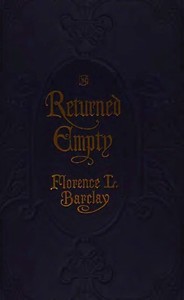
Returned Empty by Florence L. Barclay
Have you ever finished a book and just sat with it for a while, feeling the weight of the characters' choices? That's Returned Empty. It starts with a shock: Sir Deryck Brand, a respected baronet, simply disappears. He leaves no note, gives no reason. His wife, Jean, is left to manage their estate and face the whispers of society alone. For ten long years, she hears nothing.
The Story
Then, out of the blue, Deryck comes back. But he's a ghost of his former self—withdrawn, broken, and unable to explain his absence. The book isn't a thriller about his missing decade. Instead, it's a close-up look at what comes next. Jean must navigate her own mixed feelings of love, betrayal, and duty. Deryck struggles with a deep shame and a pain he can't voice. The story unfolds in the quiet rooms of their home, in strained conversations, and in the small, brave acts of trying to reconnect. The central question isn't 'Where were you?' but 'Can we ever find our way back to each other?'
Why You Should Read It
Barclay writes about marriage with a startling honesty for her time. This isn't a flashy romance; it's a story of stubborn commitment. Jean's strength isn't in dramatic speeches, but in her daily decision to stay, to understand, and to hope. Deryck's journey feels true to the slow, non-linear path of healing from psychological wounds. What got me was the book's patience. It allows its characters to be confused, to make mistakes, and to heal in tiny increments. It argues that love isn't just a feeling of passion, but an action—a choice to rebuild, piece by piece, even when the blueprint is lost.
Final Verdict
Perfect for readers who enjoy character-driven stories from authors like Frances Hodgson Burnett or Gene Stratton-Porter. If you like your drama internal, focused on emotional landscapes rather than grand adventures, this is your book. It’s a thoughtful, compassionate look at trauma, resilience, and the quiet power of a love that refuses to let go. Just be ready for a read that’s more about the ache of mending than the break itself.
This publication is available for unrestricted use. It is now common property for all to enjoy.
Susan White
5 months agoHaving explored several resources on this, I find that the way it challenges the status quo is both daring and well-supported. I'm genuinely impressed by the quality of this digital edition.
Joseph Williams
10 months agoRight from the opening paragraph, the quality of the diagrams and illustrations (if applicable) is top-notch. This adds significant depth to my understanding of the field.
Donald Lopez
11 months agoLooking at the bibliography alone, the objective evaluation of the pros and cons is very refreshing. It cleared up a lot of the confusion I had previously.
David Lewis
1 month agoComprehensive and well-researched.









Susan Thompson
1 year agoA brilliant read that I finished in one sitting.