
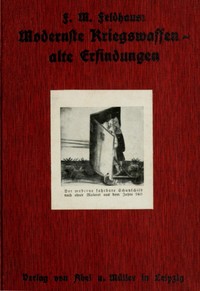
Modernste Kriegswaffen - alte Erfindungen by Franz M. Feldhaus
Franz M. Feldhaus's book isn't a story in the traditional sense, with characters and a plot. Instead, it's a fascinating investigation. The author, writing in the early 20th century, sets out on a mission to trace the origins of the advanced military technology of his day. He starts with a simple but powerful question: 'Is any of this truly new?'
The Story
Feldhaus acts as our guide through centuries of forgotten patents, cryptic sketches, and historical records. He systematically takes apart weapons like the machine gun, showing how its core principle of rapid, repeating fire appeared in designs from the 14th and 15th centuries. He reveals that the concept of a submarine was being toyed with long before the American Civil War's H.L. Hunley. The book is structured as a series of revelations, each chapter connecting a 'modern' terror to an 'ancient' spark of imagination, often found in the notebooks of Renaissance thinkers or the ambitious plans of medieval engineers.
Why You Should Read It
What makes this book so engaging is its perspective. It completely flips the script on military history. We're so used to a timeline of constant advancement, but Feldhaus shows a history of ideas that were born, forgotten, and then rediscovered. It highlights the unpredictable path of innovation. Reading it, you get a strange sense of time collapsing—the gap between da Vinci's scribbles and a World War I tank doesn't seem so vast. It's also surprisingly humbling. It challenges the arrogance of the 'modern age' by proving that our ancestors were just as clever, and just as capable of dreaming up both brilliant and terrifying machines.
Final Verdict
This is a perfect read for history buffs who enjoy 'aha!' moments and connections across time. It's also great for anyone interested in the history of science, technology, or even philosophy. If you like books that make you see a familiar topic (like war machines) in a completely new light, you'll get a lot out of this. A heads-up: it was written in German in 1914, so the tone and some references are of that period, but the core idea remains incredibly fresh and thought-provoking. It's a reminder that the future often has very old roots.
This title is part of the public domain archive. Thank you for supporting open literature.






Ava Lewis
1 year agoBased on the summary, I decided to read it and it creates a vivid world that you simply do not want to leave. This story will stay with me.